
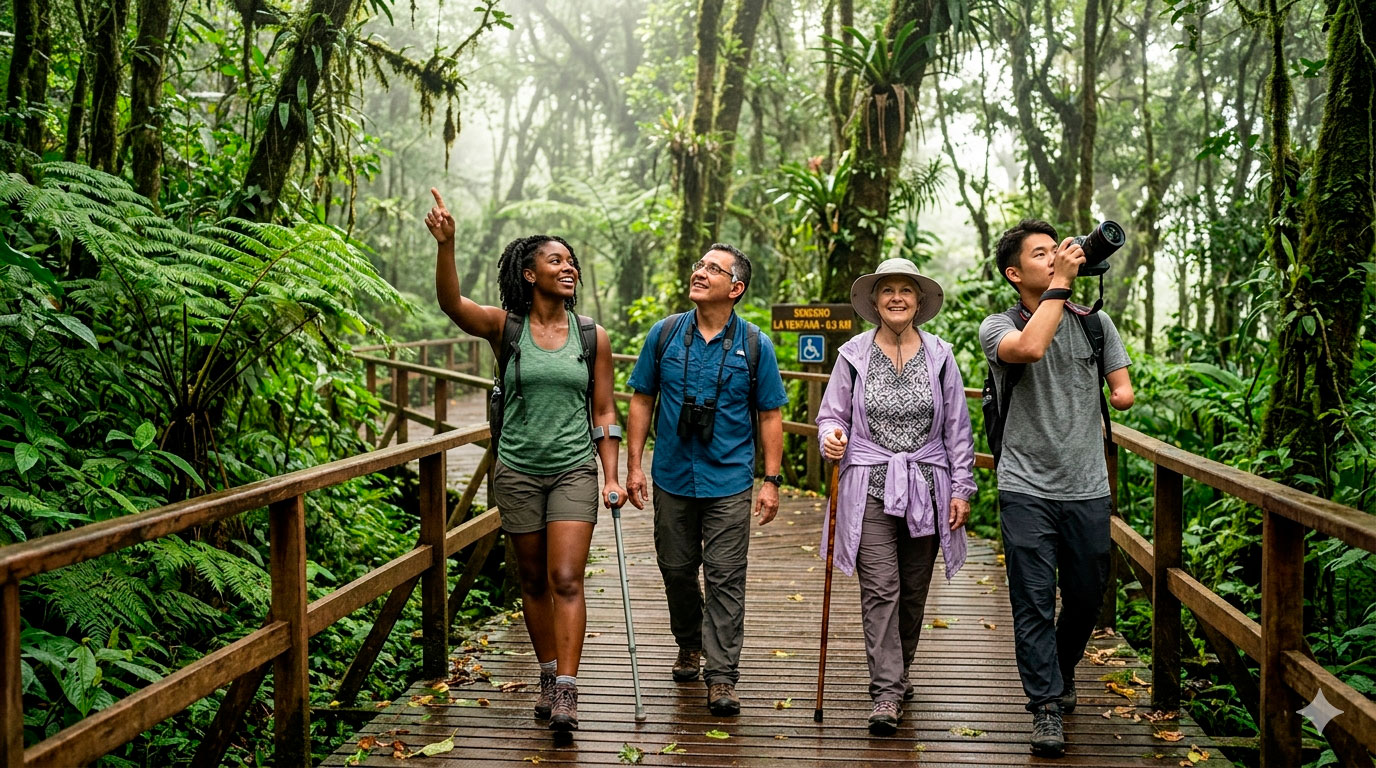
Why Accessibility Benefits Everyone (Not Just a Few) — And the Misconceptions Around It
When people hear the word accessibility, they often think it applies only to travelers who use wheelchairs, have visible mobility challenges, or are deaf and blind. But the truth is much broader—and far more interesting.
Another common misconception is that only older travelers need special attention and services. That simplifies the issue. Accessibility serves a wide range of people, including:
– Pregnant women
– Parents traveling with toddlers
– Children with conditions such as Botulism or Guillain–Barré syndrome
– Skiers recovering from injuries
– Athletes with fractures
Over the years, while assisting travelers, I have found that many of my passengers are actually younger individuals dealing with serious injuries or lifelong physical conditions. What they all share is vitality, energy, and a strong desire to explore the world. What they need is not limitation—but thoughtful planning, attention, and professional care.
Accessibility Improves Travel for Everyone
Accessibility, when done well, improves the travel experience for everyone.
Think about it: a step-free entrance is essential for someone using a wheelchair, but it is also a relief for a traveler with a heavy suitcase, a parent with a stroller, or someone recovering from an injury. Clear signage and well-organized spaces are critical for travelers with cognitive or sensory challenges, but they also make airports, museums, and cities easier to navigate for all of us—especially when we are tired, jet-lagged, or in an unfamiliar environment.
Destinations Leading the Way
Destinations around the world are slowly beginning to understand this. Cities like Medellín, with its innovative public transportation system, or Buenos Aires and Machu Picchu, known for their relatively flat layouts and wide sidewalks, show how thoughtful design can create more inclusive and enjoyable experiences for a wide range of travelers.
But accessibility is not just about infrastructure. It is also about service, attitude, and awareness. A well-trained guide who understands different needs, a hotel staff willing to adapt, or a carefully planned itinerary can transform a trip—not only for those who require accommodations, but for everyone in the group.
Accessibility Is Part of Who We Are
In reality, most of us will experience limited mobility at some point in our lives—whether temporarily or permanently. Accessibility is not a niche concern; it is part of the natural diversity of human experience.
This is why accessible travel is not a luxury or a special request. It is, quite simply, good service in travel.
When destinations, hotels, and tour operators embrace accessibility, they are not just opening their doors to more people—they are creating smoother, more comfortable, and more meaningful journeys for all.
At Accessible Travel Americas, we believe accessibility is not an added service—it is the foundation of a well-designed travel experience.
— Consuelo